Revolution Brush: A Hand-Painted Script Font That Elevates Real Branding
Last Tuesday, I was helping a local candle maker update her jar labels—simple white kraft paper, black ink, minimal layout. She’d been using a free script font she found online, but something felt “off”: the letters looked stiff, disconnected, like they were trying too hard to be elegant. When she switched to Revolution Brush, the difference wasn’t subtle—it was immediate. The warmth in the strokes, the gentle taper of each curve, the way the “s” and “g” flowed like ink still wet on paper… suddenly, her brand didn’t just look handmade—it *felt* handmade.
What Makes Revolution Brush Feel So Human?
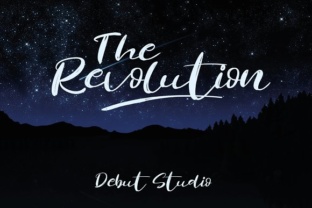
Revolution Brush is a delicate, hand-painted script font created with a fine brush pen—not a tablet or vector tool. That means every letter carries subtle variation: slight pressure shifts, organic line thickness, soft entry and exit strokes. It’s not perfectly symmetrical (and it shouldn’t be). That imperfection is its strength. As a Script Amp font, it sits comfortably between expressive calligraphy and approachable handwriting—refined enough for premium packaging, relaxed enough for a cozy café menu or a boutique thank-you card.
It’s not a workhorse font for body text. Think of it as your brand’s voice when it leans in and speaks directly to someone: the name on a skincare serum label, the “hand-poured” line on a candle jar, the “thank you” stamped on a folded card tucked into a gift box. Its personality is warm, confident, and quietly intentional—never fussy, never cold.
Where It Shines in Everyday Business Materials
I’ve tested Revolution Brush across real small business touchpoints—and here’s where it consistently adds polish without overcomplicating things:
- Product labels & packaging: On matte-finish candle jars or linen tea bags, Revolution Brush gives a tactile, artisanal impression—even before the customer reads a word.
- Menus & signage: At a neighborhood café refreshing their chalkboard-style menu, pairing Revolution Brush for dish names with a clean sans serif for descriptions created instant visual hierarchy and charm.
- Social media graphics: Used for Instagram story highlights (“New Arrivals”, “Behind the Scenes”) or banner text in Canva templates, it stands out without competing with photos.
- Printed collateral: Business cards, thank-you notes, and seasonal flyers gain quiet sophistication—especially when printed on textured paper that echoes the brush’s organic grain.
- Online shop banners & digital ads: Short phrases like “Small Batch • Made With Care” pop beautifully at larger sizes, reinforcing authenticity in crowded feeds.
Readability Matters—Here’s What to Know
Because Revolution Brush is a display font, legibility depends on context. It shines at 24pt and up for print, and 36px+ on screens. For tiny labels (like 8mm tall product tags), stick to short words—“Lavender”, “Oat Milk”, “Limited Edition”—and avoid dense blocks of text. On mobile thumbnails or social previews, test how it renders at smaller sizes: some characters (like the lowercase “f” or connected “th”) benefit from generous spacing or slight tracking adjustments.
One note: Revolution Brush works best for short, high-impact phrases. Use it for headlines, logos, titles, and decorative accents—not for ingredient lists, shipping policies, or multi-paragraph bios. Let it lead; let another typeface support.
Simple Pairings That Just Work
You don’t need design training to pair Revolution Brush well. Start with these go-to combinations:
- A clean sans serif: Try Montserrat, Inter, or Poppins for contrast. Their crisp geometry makes Revolution Brush feel even more expressive—ideal for café menus, boutique tags, or e-commerce banners.
- An elegant serif: Playfair Display or Cormorant Garamond adds timeless refinement—perfect for wedding stationery, luxury skincare, or editorial-style brand storytelling.
- A neutral handwritten companion: If you want layered texture (say, for a logo lockup), try a simpler, upright handwritten font—just one weight, no flourishes—to balance Revolution Brush’s movement.
Pro tip: Always check what’s included. Revolution Brush comes with OpenType features like ligatures and alternate characters—small details that make “The” or “And” flow more naturally. It supports basic Latin languages and ships in .OTF and .TTF formats, so it works in Adobe apps, Canva, Affinity, and most modern design tools.
Licensing Is Part of the Process
As a commercial font, Revolution Brush includes a standard license for use in client work, product packaging, digital templates, and merchandise—no hidden restrictions. Before ordering, double-check the license covers your intended use: selling physical goods (like branded mugs or tote bags), creating digital downloads (brand kits, Canva templates), or building websites for clients. Most reputable font sellers list this clearly—and if it’s unclear, ask. Good typography should empower your business, not create legal uncertainty.
At the end of the day, fonts aren’t just decoration. They’re part of your brand’s first impression—the silent handshake before a customer reads your story or tries your product. Revolution Brush doesn’t shout. It invites. It connects. And for small businesses building trust through authenticity, that kind of quiet confidence? That’s worth every brushstroke.